Toccoa River Canoeing Guide
By SUZANNE WELANDER
Family Fun on the Toccoa. The Toccoa’s many assets incude beautiful scenery, wooded seclusion and mild rapids. See more photos of the Toccoa at the end of this guide.
The Toccoa is a purely delightful mountain stream. Its upper reaches harbor a primitive woodland paddling experience with mostly mild rapids. Unregulated by dams, the river’s flow becomes the major feeder for Blue Ridge Lake. Below the dam, the river widens as it weaves through settled lands on its way to McCaysville and into Tennessee, where it is thereafter known as the Ocoee River.
From Deep Hole Campground to Blue Ridge Lake, a distance of about 17.5 miles. Allow 1-2 days. Class I-II with some III. See MAP
DESCRIPTON: While it is navigable by canoe or kayak above the junction with Cooper Creek in Fannin County, the highest usual put-in is the U.S. Forest Service campground at Deep Hole on GA 60. The first 3-mile segment traverses some farmland, some woodland, and intersects with a couple of roads before veering into the fragrant realm of the undisturbed forest. Putting in downstream of the campground where GA 60 passes near the river brings the forest’s entrance 1.8 miles closer.
Flowing through the national forest on the back side of Tooni Mountain, the river becomes a sheer delight for beginning canoeists, canoe campers, and trout fishermen. Water quality is good, and trout fishing is excellent. Add beautiful scenery, wooded seclusion, and mild rapids, and you have the perfect environment for an overnight trip.
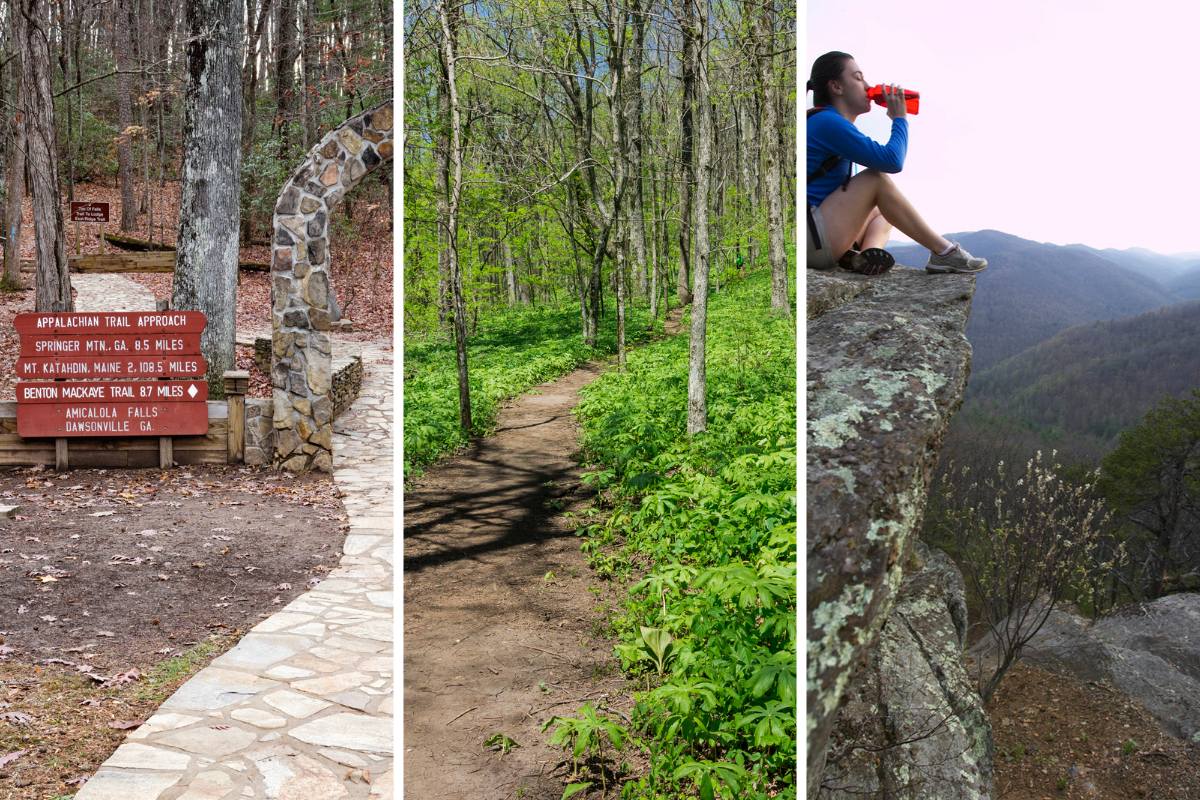
Within the forest section, fairly continuous Class I rapids keep things lively. A half-mile of Class II+ activity begins below the Rock Creek junction. The Benton MacKaye Trail, a loop of the Appalachian Trail, crosses the river via suspension bridge at this point, providing a good vantage point for scouting the largest rapid. The loop trail makes a good hiking side-trip up Tooni Mountain. Best in winter and early spring, the view of the surrounding valleys carved by the river is worth the climb.
Gradually the river leaves the seclusion of the forest and enters a picturesque valley upstream of Swan Bridge. The current remains swift and busy, with Class I activity for the next 9 miles to Blue Ridge Lake. The surrounding views are fairly pastoral, giving way to civilization mingled with intermittent brushes with forest after passing Dial Road. There are no major rapids until right before the final take-out, where the river narrows into a short series of Class II rapids that become more challenging at higher water levels. After this point, the river is quickly stilled into the backwaters of Lake Blue Ridge. Occasionally, when the lake pool is down 40-50 feet, an additional section of continuous Class II rapids is exposed. This can be run with a take-out on river right at Persimmon Creek.
Access is good throughout the upper section and easily accommodates shorter trips. A 7.2-mile stretch that includes the most remote forest segments and challenging rapids can be created by putting in at GA 60 and taking-out on Dial Road. The upper section also encompasses the 15-mile U.S. Forest Service Toccoa Canoe Trail, which stretches from Deep Hole Campground to the Sandy Bottom take-out. The trail makes for one busy or two relaxed days of paddling. Downstream, a quick 5.4-mile trip begins at the campground put-in on Aska Road and ends below the last rapid.
SHUTTLE: From GA 2/515 in Blue Ridge, turn east onto Windy Ridge Road. The road quickly comes to a stop sign; turn left. After 0.2 miles, turn right onto Aska Road. The lowest usual take-out point is 7 miles ahead on the left. Ample parking is available at the bend in the road near the top of the rapid; if you choose to run the rapid, your car can easily be moved to the more restricted pull-out near the bottom for loading. To get to the put-in, continue in the same direction on Aska Road. Along the way, you’ll pass most of the intermediate access points, with the exception of the Sandy Bottom take-out and Swan Bridge. Aska Road will eventually dead-end into Newport Road. Turn left here, then right at the next dead-end into Dial Road. Take Dial Road until it reaches GA 60; turn right. The turn for Deep Hole Campground is on the right, approximately 0.5 miles after the road rejoins the river.
GAUGE: The TVA provides data for the gauge at Dial Road on their website or by calling (800) 238-2264. The river can be run as low as 250 cfs, but is more enjoyable above 400. Experienced boaters will continue to enjoy the river at levels above 1,000 cfs, but beginners will be imperiled, particularly upstream of Dial Road, since laurel thickets eliminate eddies and block safe access to the banks in many spots. A visual gauge is located on river right between the Toccoa Valley Campground and Shallowford Bridge. Using this gauge, the minimum level is 0.7 feet, maximum 6 feet.
From Blueridge Dam to McCaysville, a distance of about 14.8 miles. Allow 6 hours. Class I. See MAP
DESCRIPTION: Below Blue Ridge Lake, the river’s gradient becomes (and remains) gentle for the 14 miles to McCaysville. Both the river and the valley widen considerably, and signs of civilization become more prevalent. Railroad tracks parallel the river most of the way. At McCaysville the river enters the Copper Basin area and is known thereafter as the Ocoee River.
SHUTTLE: From McCaysville, go east on GA 60/5 and take GA 60 south toward Mineral Bluff. Turn right onto Mountain River Road and follow it a few miles to Horseshoe Bend River Park. To the put-in, continue south on GA 60 toward Blue Ridge. Turn right onto GA 2/515; after 1.3 miles, turn left on North River Road. The put-in is at the Powerhouse River Access, less than a mile ahead. Mid-run access is reachable from GA 60 at Curtis Switch Road.
GAUGE: The TVA website provides data for the Toccoa below the dam on their website or by calling (800) 238-2264; Blue Ridge Dam is currently option #23 within their phone system. Standard operating flow when the dam is generating is 1,600 cfs, which provides plenty of water for this section and no real hazards.
MAPS: Suches, Noontootla, Wilscot, Blue Ridge, Mineral Bluff (USGS), Fannin (County)
A Canoeing & Kayaking Guide to Georgia is a compilation of paddling guides to over 80 Georgia streams and rivers, plus the Okefenokee Swamp and Georgia Coast, published by Menasha Ridge Press since 1982. Originally written by Bob Sehlinger and Don Otey, it has been extensively revised and updated by Suzanne Welander. Organized efficiently by watersheds, the book contains a wealth of interesting and useful information about Georgia physiography and paddling, in general, as well as the authoritative paddling guides. To purchase a copy of A Canoeing & Kayaking Guide to Georgia, a book every paddler of Georgia streams should have in their library (and boat), and to see over 75 other outdoor guides published by Menasha, visit the Menasha Ridge Press website.
MORE TOCCOA PHOTOS
The Toccoa is a purely delightful mountain stream. Its upper reaches harbor a primitive woodland paddling experience with mostly mild rapids.
Unregulated by dams, the river’s flow becomes the major feeder for Blue Ridge Lake.
January 1st, 2010 at 12:07 pm
On either the upper or lower Toccoa River, is powered boat operations allowed? There are certain boats built expressly for shallow water use, such as RiverPro boats. I would appreciate any information you can supply me with. I haven”t been able to find any rules or regulations about this…
Alan Norton
January 31st, 2010 at 6:06 pm
I don’t know of any restrictions on power boats, but I wouldn’t recommend it. Most places are too shallow - you will often scrape even in a canoe.
Sam